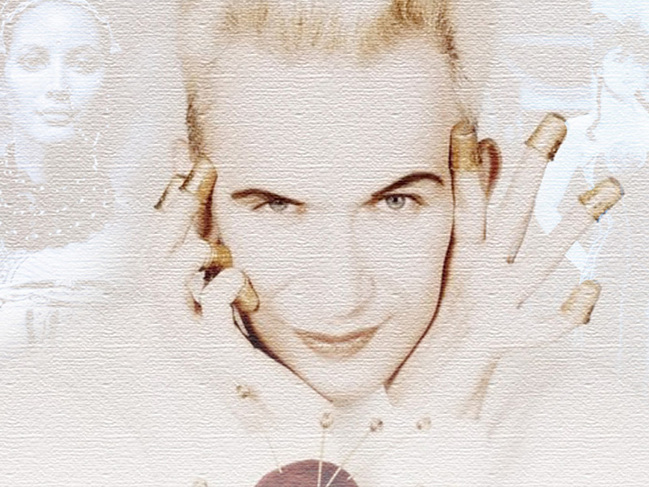
Jean Paul Gaultier turned 74 this week. Hard to believe, right? The man who once flipped French fashion on its head, a proper rebel who never cared for the stuffy rules of the old guard, is now watching his namesake label shift into a new gear under Durand Lantink. Lantink’s been at the creative helm for a full year now, steady hands guiding a legacy that’s anything but quiet. Pierre Carden, Gaultier’s old mentor, once said something that’s stuck with me for years: you can spot a Gaultier piece from across a crowded room, no logo tag needed. What else even defines a designer’s mark? That sharp, unapologetic vision of his? We’re breaking down the moments that cemented it, the stuff that made him impossible to ignore.
The Sailor and the Stripe: Early Codes of Subversion
Gaultier’s first standalone collection dropped in 1976, him and his partner Francis Menouge presenting work that was basically a pointed rejection of every sartorial norm the industry held dear. It caused a proper row among the traditionalists, as you’d expect. He didn’t formalize his own label until 1983, but even in those early days, naval tropes were everywhere. Why sailors? Gaultier always said there’s a delicious tension there: rigid military discipline clashing with the hyper-sexualized edge of subcultural style. White matelot knits, lace-up tanks, fishnet that clings like fishing line—these weren’t just shock tactics. They were a love letter to uniforms that don’t hide the body, that leave it exposed, unapologetically so. His sailors weren’t the clean-cut heroes of old movies. They were anti-heroes. Rugged, vulnerable, magnetic as hell. The Breton stripe? He lifted it from classic naval knitwear first, put it on tights, dresses, unaltered telnyashkas. Over decades it shifted from sober blue-and-white lines to psychedelic, body-hugging variations that either accentuated curves or warped them into optical illusions. Wild, really.
Fragrance as Wearable Manifesto
A decade after those early collections, Gaultier took his maritime obsession off the runway and into perfumery, launching Le Male in 1995. Francis Kurkdjian crafted the scent, housed in that iconic torso-shaped flask wrapped in striped telnyashka. It flew off shelves globally, dominating markets from Latin America to Southern Europe, becoming a defining staple of late 20th century masculine perfumery. I remember buying my first bottle in a duty-free when I was 19, the weight of the flask feeling like holding a tiny piece of Gaultier’s rebellion in my hand. Lavender, mint, vanilla—who’d have thought that blend would flip hyper-masculine fragrance tropes on their head? It wasn’t just a scent, it was a statement. Classique, his first women’s fragrance, had already paved the way: corseted flask, rum-soaked rose, vanilla, ginger. A defiant rejection of the sanitized “good girl” perfume archetypes of the era, centered on a woman who was unapologetically free, bold, loud. Gaultier was among the first to treat fragrance packaging as core creative concept, not an afterthought. Stamped metal tins instead of cardboard boxes, flasks shaped like abstract sculptures. Later flankers like Scandal, La Belle, Le Beau all leaned into his signature obsessions: bodily presence, theatrical artifice, that sense of performance he’s always loved.
Skirts for Men, Blurring the Binary
Spring/Summer 1985’s Et Dieu créa l’homme (And God Created Man) made history, plain and simple. It was one of the first mainstream shows to frame men’s skirts not as some ethnic curiosity—Scottish kilts, samurai regalia, that kind of thing—but as everyday wardrobe staples. Full skirted suits for men, wide-plaid wrap-leg trousers for the more hesitant. He kept coming back to that silhouette his whole career. David Beckham wore a printed sarong of his in the late 90s, cemented the style in pop culture memory. Gaultier himself favored kilt variations, never shy about wearing his own designs. Ricky Martin, Marc Jacobs, Brad Pitt—all of them wore his kilts, Pitt even photographed in one for a 1999 editorial. Was this just shock value? Hardly. It was a deliberate push against rigid gendered dress codes, a way to say clothes don’t have a gender, people do. Spring/Summer 1993, he dressed women in high-waisted suit trousers with chest-crossing suspenders, erasing the line between masculine tailoring and feminine form entirely. Bold moves, all of them.
Nudity as Political Gesture
Gaultier’s play with androgyny always went hand in hand with strategic, deliberate partial nudity. No contradiction there. For him, exposed skin was never just erotic fodder, never just a way to sell clothes. It was a political, cultural, artistic statement. He’d ask: why is a woman’s body a site of public debate? Who controls the gaze—the model, or the person watching? Why is one gender allowed to bare their torso freely, while another gets policed for the exact same act? September 2, 1992: he took a bow with Madonna at an amFAR fundraiser, both in suits with cut-out chest panels. Nearly a decade later, Spring/Summer 2002: Naomi Campbell walked the runway with her hands cupped over her bare breasts, Carla Bruni in a gown with a back cut so low it dipped past her waist. He treats the body as a canvas, tests the boundary between flesh and fabric, then gleefully erases that line entirely. Daring? Absolutely. Necessary? Even more so.
Tattooed Textiles: Skin as Narrative
Gaultier’s obsession with the body as a storytelling surface crystallized in Spring/Summer 1994’s Tatouage collection. He literally “painted” models’ skin via print. Semi-sheer tops, leggings, dresses covered in tattoo motifs: tribal patterns, Japanese and Slavic folk designs, old-school anchors, dragons, indigenous body art references. Layered under fine mesh to create uncannily realistic effects. This wasn’t romanticizing subculture, not for a second. It was treating skin as a narrative surface, imprinting identity and lived experience onto fabric. The motif popped up again in his couture lines, in uniforms for Paris cabaret Crazy Horse, even in a dedicated Tattoo collection released in 2024. It paved the way for similar work at Maison Margiela, Acne Studios, Marine Serre—cementing tattoo-print textiles as a lasting industry trend. Who’d have thought a 1994 collection would still be shaping fashion three decades later?
The Conical Bra: Armor for a New Femininity
The conical bra is Gaultier’s most recognizable design, bar none. First introduced in 1983, it became a global pop culture touchstone in 1990 when Madonna wore variations throughout her Blond Ambition Tour. I was 12 when that tour hit, didn’t understand half of what it was saying then, but knew that bra was something else entirely. The silhouette shattered lingerie’s place in the public eye, became a symbol of a new kind of femininity: aggressive, self-possessed, unapologetically sexual, no apologies asked. It nods to 1940s and 50s lingerie archetypes, but Gaultier stripped away all the soft romance. Rounded cups replaced with sharp, pointed cones, the architectural shape reading more like body armor than intimate apparel. A sly parody of traditional feminine ideals. He often recounts that the first iteration came when he was six years old: he crafted a corset out of newspaper and string for his stuffed bear, Nana. Six years old. That’s the kind of vision we’re talking about.
Cosmic Couture: The Fifth Element
1997, Luc Besson asked Gaultier to design costumes for his sci-fi blockbuster The Fifth Element. His first major film project. He created over 900 looks for the film, blending futuristic corsets, plastic armor, asymmetric slits, bandage wraps, bare skin, exaggerated silhouettes—all his core codes, reimagined for a cosmic setting. The most iconic? Milla Jovovich’s Lelu: a minimalist white bodysuit made of interlocking plastic strips, baring skin strategically, functioning as both battle armor and erotic fantasy. Tattoo prints, lingerie structures, uniform tropes all made an appearance, not as a prediction of future fashion, but as a critique of 1990s norms around sexuality, hierarchy, bodily autonomy, viewed from a distant, extraterrestrial vantage point. Wild to think a sci-fi movie could say so much about real-world politics.
Sacred and Profane: Religious Iconography
Gaultier’s use of religious iconography is probably the most polarizing part of his career. First explicit merge of confessional dress codes and deconstructed fashion came in Autumn/Winter 1993, unofficially dubbed Rabbis Chic by the press. Models walked in reinterpretations of Hasidic style: floor-length black coats, felt fedoras, payot curls, men’s suits tailored to female bodies. Spring/Summer 1998 leaned into Christian imagery explicitly: dresses with crucifixes, halos, references to Renaissance Marian art, made from tulle, guipure, velvet that clashed jarringly with exposed breasts, hips, midriffs. Frida Kahlo was a secondary touchstone for that line. He revisited spiritual themes in 2007 with Tribute to Religion, expanding to a multicultural scope: Buddhist robes, Catholic nun habits, Indian saris, Eastern priestess attire, building a sort of cosmopolitan, interfaith pantheon. Critics were split down the middle: some called it a brave cultural collage, others decried it as sacrilegious aestheticization of the sacred for shock value. Can you blame them? Or him? It’s a fine line to walk.
Optical Illusions and Trompe-l’œil
1997 couture collection Les Amazones saw Gaultier turn to op art and geometric experimentation, drawing on the work of Hungarian op art pioneer Victor Vasarely. Hypnotic geometric prints on fabric stretched and warped silhouettes, playing with viewer perception. Built on the narrative-driven print work of his Tatouage collection, but added a layer of deliberate optical trickery. He leaned heavily into trompe-l’œil techniques too, painting corsets, garters, even bare skin directly onto dresses, knits, tops. A 1984 bodysuit printed with hyper-realistic muscle definition is now core to the brand’s DNA, reinterpreted repeatedly by guest designers in later couture collections. It’s a testament to how ahead of his time he was, really.
Boxing and the Performance of Masculinity
Men’s wear was always Gaultier’s laboratory, and Autumn/Winter 2011 delivered one of his sharpest takes: he turned the runway into a boxing ring, models cast as fighters. Gone were the traditional macho archetypes. Instead, bodies stumbled, flushed, exaggerated their strength to the point of parody. Printed muscles looked glued on, faces dusted with fake bruises, gloves more theatrical than athletic. He focused on undergarments: boxer briefs worn over trousers, padded crotches, exaggerated proportions. All part of his lifelong project to show that clothing is never just fabric, it’s a layer of social expectation draped over the body. Mixed reactions, as always. Some praised the theatricality, others recoiled from the hyper-masculine posturing. But that tension? That’s exactly the point. Gaultier never offered a “correct” vision of manhood, just an invitation to see the archetype as a mask. What’s more honest than that?
A Legacy Left Open
When Gaultier announced his retirement from haute couture in 2020, it wasn’t a full stop. It was a new chapter. Instead of shutting down his label, he pioneered an unprecedented format: each couture season would be designed by a guest creative director. Chitose Abe of Sacai was first, followed by Glenn Martens, Olivier Rousteing, Haider Ackermann, Julien Dossena, Simone Rocha, Nicolas de Felice, Ludovic de Saint Sernin. Each injected their own codes into Gaultier’s core archetypes: corsets, tattoos, uniform tropes, gender ambiguity. Ackermann’s take was poetic, minimalist. Rocha filtered his work through Victorian femininity, distorted innocence. De Saint Sernin leaned hard into maritime aesthetics. No designer of his stature had ever turned their brand into such an open, collaborative stage. The guest designer format wrapped in 2025, the label now settling into a steady rhythm under full-time creative director Durand Lantink, who’s still reinventing Gaultier’s enduring codes for a new era. Seventy-four years old, and his legacy is still breathing, still shifting, still surprising. That’s the mark of a true great.